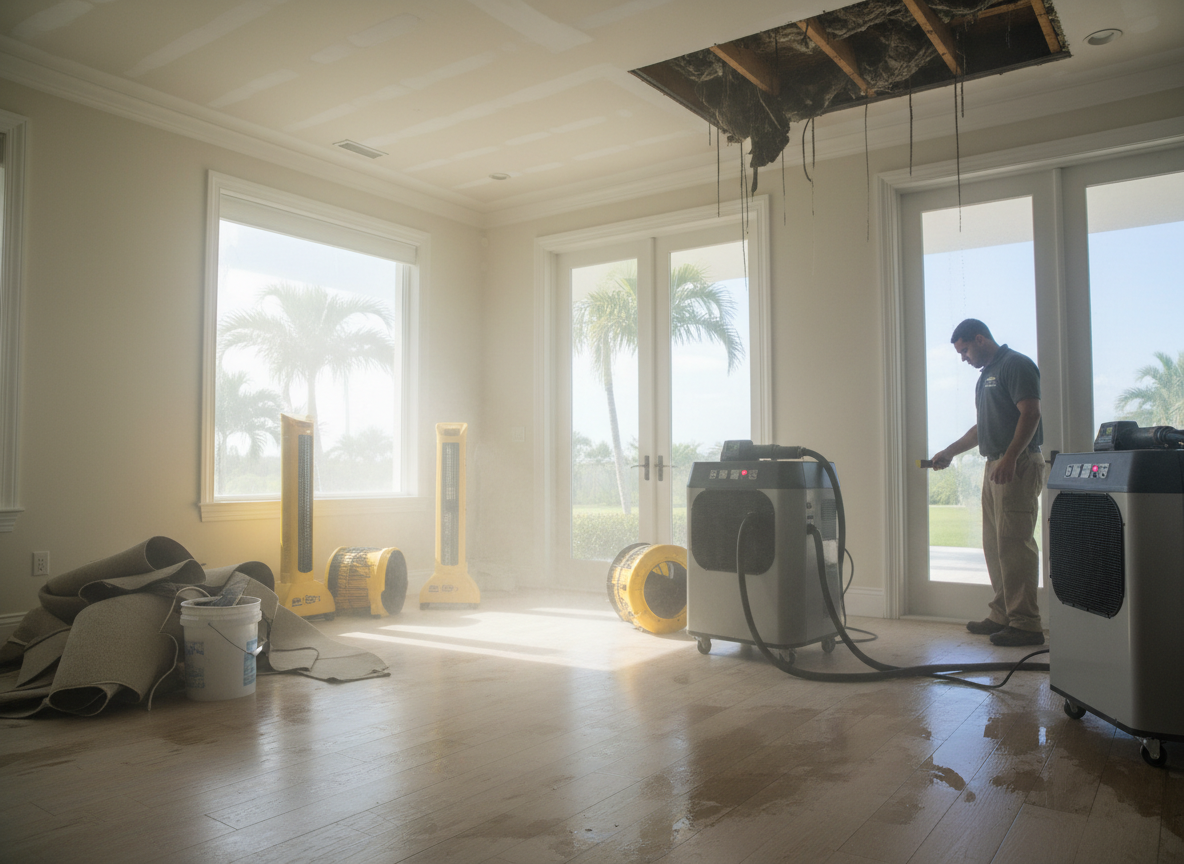
Lighthouse Point is a canal city of about 10,500 people at the north end of Broward County, built on dredged waterways in the 1950s and 1960s. Most of its homes are single-family and many front on water, with the Intracoastal along the eastern edge. This page explains how we read a Lighthouse Point house before we scope the work.
What should a Lighthouse Point homeowner know first?
Lighthouse Point covers roughly 2.3 square miles of land in the northeast corner of Broward County, with about 18 miles of canals and waterways cut through it. It is small, largely built out, and the water is not scenery at the edge of town. It runs behind the houses. That single fact shapes almost every water call here, because the canal, the ground and the inside of the house are connected.
A small city organised around its canals
Lighthouse Point became a city in the mid-1950s and grew by dredging canals and filling the lots between them. The result is a grid of short streets where the rear of many properties is a seawall and a dock rather than a fence. Homes on the canals have boat access to the Intracoastal, and the city's identity is tied to that water access. Commercially, the city is compact, with most of its shops and services along Federal Highway and Sample Road, and the rest is residential. For a water loss, the layout matters in two ways: access for equipment can be tight on a narrow street, and the water table under a canal-front lot is never far below the surface.
Housing from the 1950s and 1960s
Most of the housing stock was built between the 1950s and the 1970s, in concrete block and stucco, with a mix of one-storey ranches and later two-storey homes. Many houses have been added to, re-roofed and re-plumbed, and some have not. At fifty to seventy years old, the original supply lines, drains and valve bodies are at the age where failures are routine rather than unusual. A house that has had a kitchen and two bathrooms renovated may still have the original line running through the ceiling to the air handler. Additions are common, and an addition is where the old roof meets the new wall, which is where water often enters.
Canals, tide and the Intracoastal
The canals are tidal. Water levels rise and fall with the Intracoastal and the inlet, and during a spring tide, a heavy rain or a storm, the canal can come up over a seawall and across a dock and pool deck. The ground is low, about seven feet above sea level, and the water table responds to the canal. That means a canal-front lawn can be saturated for days, a pool deck can hold water, and the base of an exterior wall can stay damp long after the rain has stopped. Salt air also works on the building envelope, which is a maintenance issue as much as a water one.
Who serves a Lighthouse Point address
Lighthouse Point is its own municipality inside Broward County. The city handles building permits and most local services, and the Broward County property appraiser record confirms the jurisdiction and the lot for a specific parcel. Some properties sit in a community association or a plat with its own rules, but most of the city is not gated. Flood maps are the part owners most often misread: much of the canal-front property sits in a higher-risk zone, and the effective map for the parcel should be checked rather than assumed. Water and sewer service comes from the city utility, and the bill identifies the account.
Matching the work to a Lighthouse Point property
On a canal-front lot the first task is to separate three sources that look alike at the wall base: a pipe inside the house, rain driven through an opening, and water that came up from the canal. The service that follows depends on that answer, not on the address.
- Water damage repair handles drying and the interior repairs inside our scope after a supply line, water heater or appliance failure.
- Water extraction comes first when water is standing or has soaked carpet, pad, a closet floor or a cabinet base.
- Mold remediation applies where a wall, ceiling or cabinet has stayed damp long enough to grow, which is common in houses left closed for the summer.
- Storm damage restoration covers wind and rain entry at roofs, windows, doors and the seam where an addition meets the original wall.
An inland ranch on a 1960s street usually needs the plumbing read first. A canal-front house needs the exterior line read first. Same city, different order.
Why we work this part of Broward
We come north from N Dixie Hwy through Deerfield Beach, about 8.5 miles, and work in the block ranches and canal-front houses that make up most of Lighthouse Point. The streets are narrow, the lots are close to the water and equipment has to be carried in rather than parked at the door. We plan that before the visit. The city issues its own building permits, and we say plainly which part of the job belongs to a plumber, a roofer, a seawall contractor or the city. This site does not publish licence numbers, certifications or reviews.
Why a Lighthouse Point leak outlasts the weather
Tide is the variable an inland city does not have. The canals rise and fall with the Intracoastal and the inlet, and during a spring tide or a storm the water can cross a seawall and sit against a pool deck, a door track and the wall base. The ground is about seven feet above sea level and the water table follows the canal, so the soil cannot absorb what the canal pushes back. Salt air adds a second problem: it works on stucco, paint and metal, and a wall that stays damp near the coast deteriorates faster than the same wall inland.
Inside the house, the plumbing is the other clock. A 1950s or 1960s supply line, angle stop or drain has had decades to corrode, and a slow leak above a ceiling can run for weeks. When an addition was built, the seam between old roof and new wall became a third entry point. None of these announces itself. The stain or the smell is usually the last evidence, not the first.
Where water hides in a Lighthouse Point home
The first place we read on a canal-front property is the wall base and the floor beside the sliding doors and the pool deck, because that is where canal water and wind-driven rain arrive. The second is the cabinet toe kick in the kitchen and bathrooms, where a slow leak collects out of sight. The third is the ceiling below the air handler or the upstairs bathroom, where a line or a pan drain has been dripping into insulation.
Older houses add their own hiding places. A terrazzo floor can conceal a damp slab and a saturated baseboard without showing much on the surface. A furred-out wall over concrete block can hold water between the furring and the block. An addition often has a low roof or a flat section that ponds, and the seam where it meets the original wall is a common entry point. We read all of those points with meters and thermal imaging before we open anything, and we photograph the readings so the scope rests on evidence rather than a guess.
The order of work in Lighthouse Point
- The call establishes whether the property fronts on a canal, whether anyone is home and whether water is still visible.
- We read the exterior first: wall base, door tracks, pool deck and dock, with photographs of the water line while it is still there.
- Inside, we read the wet rooms and the assembly around them with meters and thermal imaging before opening anything.
- Containment goes up, contents move clear, and filtration is set where growth is being disturbed.
- Standing water is extracted, material that cannot be dried is removed, and drying equipment is set at marked points.
- At hand-back we compare readings with day one and name the exterior repair separately from the interior work.
What's included in a Lighthouse Point scope
- A photograph of the exterior water line before it is cleaned away
- A written separation of canal water, rain entry and plumbing as the likely source
- Thermal imaging of concealed ceilings and walls
- Containment with protected contents and a planned material route
- Extraction of standing water and removal of saturated pad, carpet or drywall
- Drying equipment monitored against marked readings
- A before, during and after photo log
- A trade split that names the plumber, roofer, seawall contractor or general contractor where the repair is theirs
The exterior line matters because it tells the owner whether the next step is a door adjustment, a drainage change or a seawall conversation. Without that record, the interior dries and the same wall gets wet again at the next high tide.
What to check before the next high tide
Look at the door tracks and the pool deck drains, and clear them. Check the water heater pan and its drain, the supply lines above the ceiling, and the angle stops under every sink. If the house will be empty for the season, shut off the water at the main and leave the air conditioning on a dehumidifying setting. Photograph the interior while it is dry and note how high the canal comes during a spring tide. That note is more useful than a guess after the next storm.
Three Lighthouse Point calls, three different jobs
A ranch with a wet cabinet base: the angle stop under the kitchen sink has been weeping for weeks, the cabinet floor is saturated and the wall behind it is damp. We shut off the water, read the cabinet and wall, remove the failed base and dry the cavity before the plumber replaces the stop.
A canal-front house after a high tide: water is at the wall base and the sliding door, the roof is sound and no pipe has failed. We separate the canal source from the interior damage, dry the room and name the drainage, door or seawall repair.
A two-storey house with a stain below an upstairs bathroom: the supply line behind the vanity has failed and the ceiling board and insulation are wet. We read the ceiling and joists, remove the saturated board and dry the assembly before the line is repaired. Three addresses, three sequences, one rule: find the water before removing anything.
Nearby areas we also serve
Lighthouse Point sits between Deerfield Beach and the Hillsboro Inlet, and we work in the neighbouring communities as well:
- Deerfield Beach, about 3 miles north
- Boca Del Mar, about 6 miles northwest
- Sandalfoot Cove, about 7.5 miles west
- Highland Beach, about 8.7 miles north
- Mission Bay, about 9.9 miles northwest
Each of those pages explains the housing and the water pattern in that community.
Arrange a Lighthouse Point visit
Call (561) 960-0937. Describe the house, whether it fronts on a canal, and what you have already turned off. Tell us if the home is occupied and whether water is still visible. We will explain what the visit involves and what can be assessed from the description before a time is booked.
Around Lighthouse Point
We regularly work near:
- 📍Dan Witt Park
- 📍Frank McDonough Park
- 📍Exchange Club Park
- 📍Lighthouse Point City Hall
- 📍Hillsboro Inlet
- 📍Sample Road
Mold Remediation in Lighthouse Point — Local Notes
- •Lighthouse Point is its own city in Broward County, not part of Boca Raton or Deerfield Beach.
- •The canals are tidal and connect to the Intracoastal Waterway.
- •Most homes were built between the 1950s and the 1970s, and many have been added to since.
- •Land elevation is about seven feet, and the water table follows the canal.